Water for coffee: hardness, filtration, SCA recipes
Updated:
Good water for coffee has a mineralisation (TDS) in the 75-250 mg/l range, general hardness of 50-175 mg/l CaCO3 and carbonate hardness of 40-75 mg/l CaCO3 - these are the SCA ranges. In practice: filtered tap water or soft bottled water. A cup is more than 98% water, so if good beans taste flat or bitter, the culprit is usually the tap, not the roaster. Below are three practical solutions - from a jug to your own recipe.
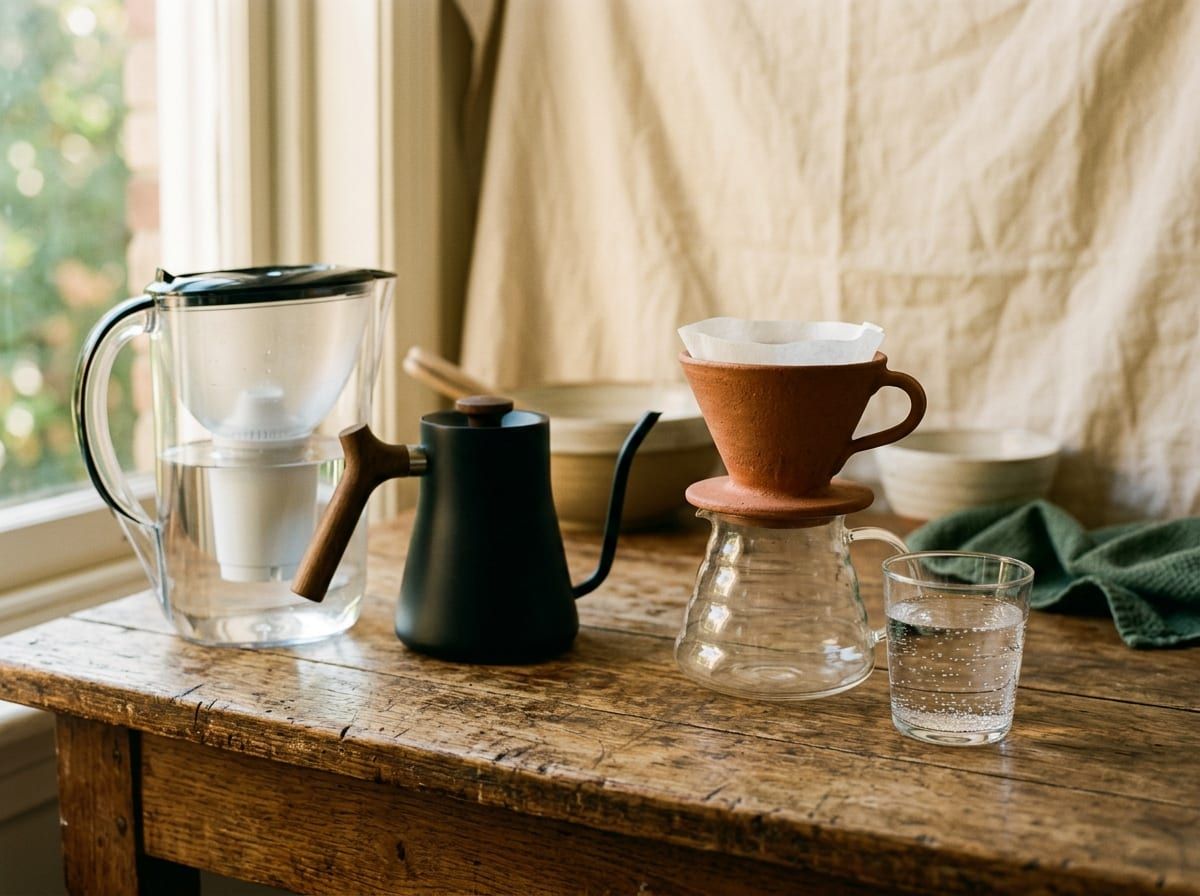
Why does water change the taste of coffee so much?
Minerals in water are not a backdrop - they take an active part in brewing. Magnesium and calcium ions "pull" flavour compounds out of the coffee (magnesium does this especially well for fruity notes), and bicarbonates act as a buffer that neutralises acids. Too few minerals - coffee is flat, hollow and aggressively sour. Too much buffer - coffee is dull, chalky, without juiciness, but with bitterness. On top of that, chlorine from tap water adds a medicinal aftertaste, and carbonate hardness builds up as scale in the kettle and in the boiler of an espresso machine.
Three numbers you need to know
General hardness (GH) is the sum of calcium and magnesium ions - the "extraction strength" of the water. Carbonate hardness (KH, alkalinity) is the buffering capacity - the "acidity damper". TDS is the total dissolved solids. All three are expressed in mg/l (ppm), usually as CaCO3 equivalent. The Specialty Coffee Association (SCA) gives the following ranges for brewing water:
| Parameter | SCA target | Acceptable range |
|---|---|---|
| TDS (mineralisation) | 150 mg/l | 75-250 mg/l |
| General hardness (GH) | approx. 68 mg/l CaCO3 | 50-175 mg/l CaCO3 |
| Alkalinity (KH) | approx. 40 mg/l CaCO3 | 40-75 mg/l CaCO3 |
| pH | 7.0 | 6.5-7.5 |
| Chlorine | 0 mg/l | 0 mg/l |
The problem: water in most Polish cities has a general hardness of 250-350 mg/l CaCO3 and high alkalinity - two to four times above the range. Such water suppresses acidity and aroma, exactly what you pay for in specialty coffee. You can check your own figures on your local waterworks' website or with a GH/KH aquarium test (15-30 zł).
Solution 1: a filter jug (from 60 zł)
A jug with a carbon/ion-exchange cartridge (Brita, Dafi, Aquaphor - jug 60-150 zł, cartridges 10-20 zł a month) removes chlorine and part of the carbonate hardness. It will not give you perfect SCA water, but in hard city water the improvement in the cup is immediate and clear - especially in light, acidic coffees from Ethiopia or Kenya. It is a sensible home standard: no measuring, small investment, big gain. Just remember to replace the cartridges - an exhausted filter stops holding anything back.
Solution 2: shop-bought water (read the label)
The brand does not matter, the numbers do. Look on the label for: total mineralisation 100-300 mg/l, calcium + magnesium combined up to about 50 mg/l, bicarbonates (HCO3) below 100 mg/l. In Polish shops some spring and low-mineral waters hit these figures; classic mineral waters (the "health" ones, 600-1500 mg/l) are far too hard for coffee. The cost is about 2-3 zł per 1.5 l, i.e. 40-60 zł a month with two coffees a day - convenient to start, expensive and un-ecological in the long run.
Solution 3: compose the water yourself (about 25 zł to start)
Full control for pennies: the base is demineralised water (4-6 zł for 5 l in any supermarket), to which you add minerals from two concentrates. You need Epsom salt (magnesium sulfate, pharmacy or garden shop, about 10-15 zł/kg), baking soda and a 0.1 g scale.
- GH concentrate (magnesium): dissolve 20 g of Epsom salt in 1 l of demineralised water.
- KH concentrate (buffer): dissolve 6.8 g of baking soda in 1 l of demineralised water.
- Brewing water: to 1 l of demineralised water add 10 ml of each concentrate.
Water composed this way has about 80 mg/l general hardness and about 40 mg/l alkalinity (as CaCO3) - right in the SCA range, with magnesium as the main extraction mineral. Keep the concentrates in the fridge and use them within 2-3 weeks. A ready-made alternative is mineralising sachets in the style of Third Wave Water (about 80-120 zł per pack for ~45 l) - the same effect without weighing.
Water, espresso and machines
With espresso and automatic machines, water is also a question of the equipment's lifespan. Carbonate hardness precipitates in the boiler as scale - which is why cafes filter water at the group head (BWT or Brita in-line cartridges) and home-machine makers force descaling. A safe direction for home: water with SCA parameters protects both the taste and the heating element. Beware reverse osmosis without remineralisation - water that is almost mineral-free is corrosive to boiler components and hollow in taste.
The most common water mistakes
- Water standing in the kettle since yesterday - it loses dissolved gases and tastes flat before it even meets the coffee. Pour fresh water for every brew.
- Repeatedly re-boiling the same water - each boil concentrates the minerals, because only pure water evaporates. After two rounds you have harder water in the kettle than from the tap.
- Replacing the jug filter "when I remember" - a cartridge past its date does not filter, and sometimes gives accumulated compounds back. Set a reminder every 4 weeks.
- Mixing tap and demineralised water by eye - without a GH/KH test you do not know what you got. For 15-30 zł an aquarium test turns guessing into a recipe.
- Judging after a single brew - water differences are heard best side by side, on the same coffee and method. A single cup misleads.
Quick test: is water spoiling your coffee
Brew the same coffee twice with the same method (e.g. V60, 15 g to 250 g of water, 93 °C): once on tap water, once on bottled water with label figures close to SCA. If the second cup is clearly livelier, sweeter and more aromatic - you have your answer and a reason to adopt one of the three solutions above. The difference is sometimes bigger than between coffees from two different roasters. You will find the gear and ratios for this test in the getting-started guide. For certainty, ask someone to hand you both cups unlabelled - a blind test removes suggestion, and the result is often surprisingly clear-cut. Note which water won with light and which with dark roasts: a buffer that mutes a light Ethiopia can soften the bitterness of a dark Brazil.
Frequently asked questions
- Does boiling the water change anything?
- Boiling removes some chlorine and precipitates a small part of the carbonate hardness (the scale in your kettle is exactly that), but it will not turn hard water into soft water. You boil water for coffee anyway, so it is no extra step - just do not treat it as a water treatment method.
- Is a filter jug enough?
- In most Polish cities, yes - it is the biggest improvement for the least money. A carbon/ion-exchange cartridge removes chlorine and lowers carbonate hardness, which hurt coffee the most. Replace the cartridge as instructed (usually every 4 weeks), because an exhausted one stops working.
- Which bottled water should I choose for coffee?
- Read the label, not the brand: look for total mineralisation of 100-300 mg/l, calcium and magnesium combined below about 50 mg/l, and bicarbonates below 100 mg/l. In Polish shops some spring waters hit these numbers - most popular mineral waters are far too hard for coffee.
- Can I brew with demineralised water alone?
- No. Water without minerals extracts aggressively and hollow - the coffee comes out flat and sour, and in an espresso machine such water speeds up corrosion of the components. Minerals (especially magnesium) carry flavour. Demineralised water only makes sense as a base for remineralisation.
- How do I check the hardness of my water?
- Simplest: test strips or a GH/KH drop test from an aquarium shop (15-30 zł), which measures general and carbonate hardness separately. Municipal waterworks also publish rough figures on their websites. The measurement takes 2 minutes and ends the guessing.
- Does hard water ruin an espresso machine?
- Yes - carbonate hardness precipitates in the boiler as scale, which insulates the heating element and clogs the lines. That is why manufacturers require descaling and cafes fit filters. At home: filtered or composed water, and for pressure machines also follow the manufacturer's descaling schedule.