How to start with specialty
Updated:
Specialty coffee is beans scored at least 80/100 on the SCA scale, with a traceable origin and a stated roast date - that is what sets it apart from supermarket coffee. Starting is cheaper than it looks: a burr grinder, a simple method and fresh beans from a roaster. Below is a concrete plan for your first purchases - with gear models and prices.
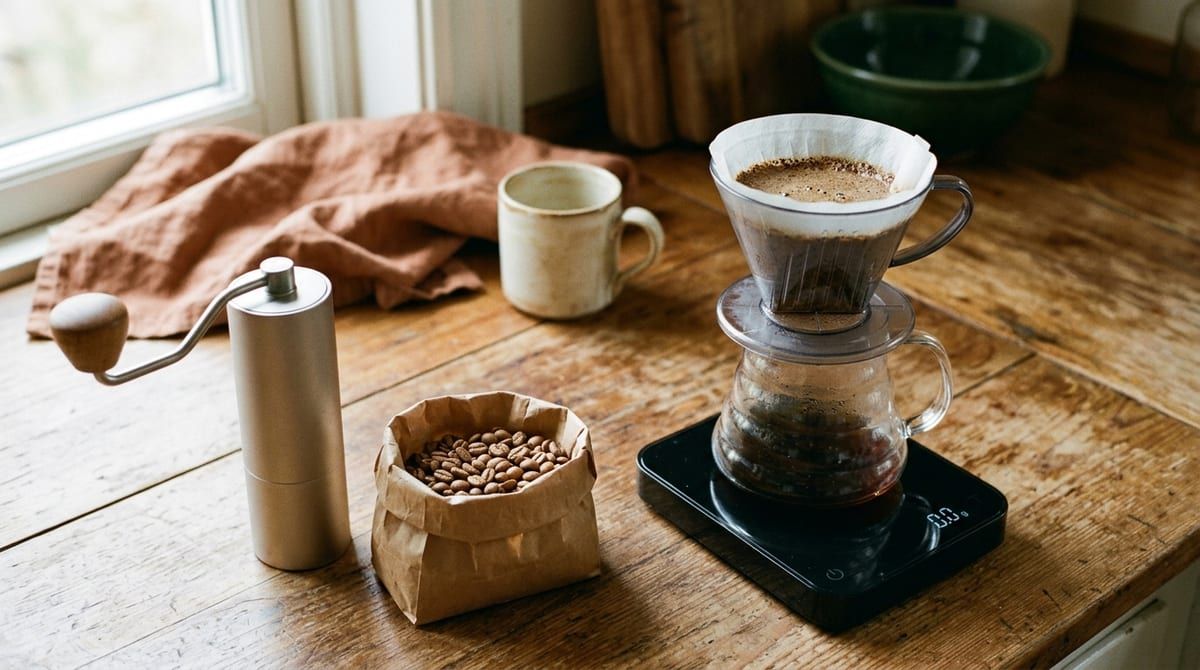
How does specialty coffee differ from ordinary coffee?
Specialty is coffee that scored at least 80 out of 100 in a professional sensory evaluation (cupping). In practice that means beans without defects, with a known origin - the bag lists the country, region and often the farm name - plus a roast date. That last part is key: coffee tastes best between the 1st and 8th week after roasting, while supermarket bags can sit on the shelf for over a year.
1. Start with the grinder, not the machine
The most important purchase is a burr grinder. Coffee loses most of its aroma within minutes of grinding, so grinding just before brewing gives a bigger jump in quality than any machine. Avoid blade grinders (the 50-80 PLN ones that look like blenders) - they cut the beans at random and give you no control over grind size.
Proven manual grinders with steel burrs (approximate prices):
- Timemore C2 (approx. 200-250 PLN) - a starter classic, grinds a pour-over dose in 40-60 seconds.
- Timemore C3 (approx. 250-350 PLN) - newer burrs, better consistency; the ESP version also handles espresso.
- 1Zpresso Q Air (approx. 350 PLN) - light, precise adjustment, great for travel.
- Comandante C40 MK4 (approx. 1100-1300 PLN) - the reference point among manual grinders, a once-a-decade buy.
If you prefer electric: the Wilfa Svart Aroma (approx. 600-700 PLN) or the Baratza Encore (approx. 800-900 PLN) will handle every pour-over method. You will find more models and selection criteria in a separate grinder guide.
2. Choose a forgiving method
Do not jump straight to espresso - it needs gear worth several thousand zloty and weeks of practice. Reach for a method that is simple and tolerant of mistakes:
- AeroPress (approx. 180-220 PLN) - the most versatile, indestructible, brews in 2-3 minutes.
- Clever Dripper (approx. 120-160 PLN) - you pour, wait, then set it on the cup. It is hardest to go wrong here.
- French Press (approx. 60-150 PLN) - you probably already own one. With a scale and good coffee it shows a whole new level.
Once you gain confidence, add the precise V60 (the plastic version costs 40-60 PLN). Each of these methods also needs a kitchen scale accurate to 0.1 g - the cheapest sensible models cost 60-100 PLN, and the Timemore Black Mirror Basic 2 about 250 PLN. Brewing "by eye" is the most common cause of disappointment: a 3 g difference in coffee changes the taste more than switching roasters does.
3. Pick your first beans
To begin with, choose a coffee with a sweet, low-acid profile. Origins like Brazil (chocolate, nuts) or Colombia (caramel, balance) work beautifully. Look for "washed" processing on the label and a light or medium roast for pour-over. A 250 g bag of specialty coffee costs 35-60 PLN - per cup that is about 2.50-4 PLN, less than the cheapest coffee in town.
Poland has dozens of specialty roasters - trusted names include HAYB and JAVA Coffee from Warsaw, Coffee Plant from Krakow and Hard Beans from Opole. Most run online shops and roast to order, so you get your bag a few days after the roast. Once you feel more confident, reach for a fruity Ethiopia to discover just how floral coffee can be.
4. Understand what you read on the bag
On a specialty bag you will find the region, the variety, the processing method and tasting notes. This is not marketing - that information genuinely tells you what to expect. Washed coffees are cleaner and more tea-like, naturals are sweeter and more intensely fruity. Tasting notes ("chocolate, orange, caramel") describe associations, not additives: the bag holds nothing but coffee. Over time you will learn that you like, say, washed African coffees or naturals from Brazil.
5. Your first brew: a recipe to start with
A universal starting point for a Clever or French Press: 15 g of coffee ground coarse (like coarse sea salt), 250 g of water at 93-95 °C, i.e. 1-2 minutes after the kettle boils. Pour it all in, stir, wait 3 minutes and decant. A 1:16 ratio (e.g. 15 g of coffee to 240 g of water) is a safe middle of the scale - a stronger cup comes from 1:14, a lighter one from 1:17.
If the coffee is bitter and drying, extraction went too far: grind coarser or lower the temperature to 90-92 °C. If it is sour and watery, grind finer or extend the time. One change at a time, so you know what worked.
Starting budget: three scenarios
| Kit | Gear | Total cost |
|---|---|---|
| Minimal | Timemore C2 + plastic V60 + filters + 0.1 g scale + 250 g coffee | approx. 350-450 PLN |
| Sensible | Timemore C3 or 1Zpresso Q Air + AeroPress or Clever + Black Mirror + 2 x 250 g coffee | approx. 700-900 PLN |
| Comfortable | Wilfa Svart or Baratza Encore + V60 + gooseneck kettle with temperature control + coffee | approx. 1800-2500 PLN |
The minimal kit is more than enough to brew coffee better than in most venues. The pricier options buy convenience and repeatability, not a different level of taste.
Starter kit: specific models
The four items from the table above as concrete, proven models. Pick one dripper: the Clever if you want good coffee without technique, the V60 if pour-over is meant to be a hobby.
Prices are approximate - check current ones in the store. We are finalising partnerships with shops: future partner links will be labelled as affiliate.
How to store coffee
Coffee has three enemies: oxygen, light and moisture. The original bag with a valve and a resealable seal is enough if you squeeze the air out after each use; a sealed container with CO2 release is more convenient (Airscape approx. 120-160 PLN, Fellow Atmos approx. 200-250 PLN). Keep coffee in a cupboard, not on the counter by the window, and not in the fridge - moisture condensing every time you take it out does more harm than the cold helps. Use an opened bag within 4-6 weeks. Freezing only works for reserves: whole, unopened bags, sealed tightly, thawed once before opening.
The most common beginner mistakes
- Stale coffee - a bag without a roast date, or opened three months ago, will ruin any method. Buy less, more often.
- No scale - "two spoons" is anywhere from 8 to 16 g. Without a scale you cannot repeat a good brew.
- Boiling water straight from the kettle - 100 °C pulls out bitterness, especially from light roasts. Wait 1-2 minutes after boiling.
- Water straight from the tap - hard, chlorinated water flattens flavour. Details in the water for coffee guide.
- Changing everything at once - new coffee, new grind and a new ratio in one brew. You will not learn what improved the taste.
Frequently asked questions
- How much does a sensible specialty start cost?
- Around 350-450 PLN: a manual burr grinder (200-250 PLN), a plastic dripper or a Clever (40-150 PLN), a scale accurate to 0.1 g (60-100 PLN) and a bag of good coffee (35-60 PLN per 250 g). This kit lasts for years and makes coffee better than most chain cafes.
- Can I start without my own grinder?
- Yes. Most roasters will grind the coffee for your chosen method at purchase. Ground coffee loses aroma far faster than whole beans, so buy smaller bags (250 g) and use them within 2-3 weeks. Buy a grinder as your first serious piece of gear - you will hear the difference in the cup right away.
- Which coffee should I buy at the very beginning?
- A washed coffee from Brazil or Colombia, light or medium roast, with notes of chocolate, nuts and caramel. That profile is sweet, low in acidity and forgives brewing mistakes. Save fruity, fermented Ethiopian coffees for your second or third purchase.
- How do I store coffee beans?
- In the original resealable bag with a valve, tightly closed, in a cupboard away from light and heat. Do not keep coffee in the fridge - it picks up moisture and odours. Ideally use the bag within 4-8 weeks of the roast date.
- Do I need a gooseneck kettle?
- Not at the start. For AeroPress, Clever and French Press a regular kettle is enough. A gooseneck (from around 150 PLN for a Hario Buono) only becomes useful with V60 and Chemex, where controlling the water stream genuinely affects extraction.
- How does specialty differ from supermarket coffee?
- Specialty coffee is beans scored at least 80/100 in professional cupping, with a known origin (country, region, often a specific farm) and a roast date on the bag. Supermarket coffees are usually blends of unknown age, roasted dark to hide bean defects.