Brewing methods guide
Updated:
Coffee brewing methods fall into three families: pour-over (V60, Chemex, Kalita - ratio 1:15-1:16, water 92-96°C, 2.5-4.5 minutes, a clean and clear cup), immersion (french press, AeroPress, cold brew - fuller body, forgiving of mistakes) and pressure (espresso, moka - small volume, big intensity). Beginners find it easiest to start with a french press or a Clever Dripper. Prefer a ready-made hint? Take the method-matching quiz - 5 questions and you have 1-2 candidates.
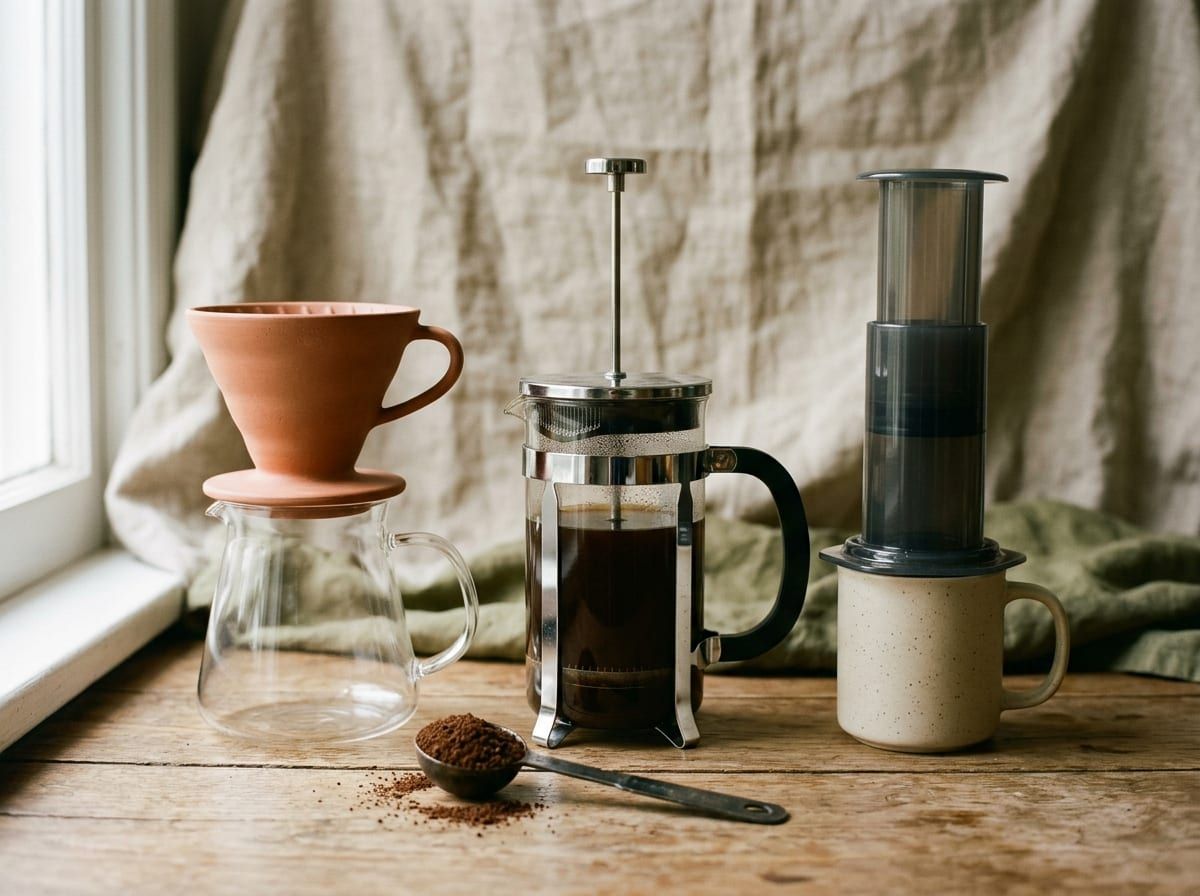
How do coffee brewing methods differ?
Every brew is an extraction: hot water washes flavour compounds out of the ground coffee. Methods differ in how the water meets the coffee - whether it flows through it, sits with it in a vessel, or is forced through it under pressure. Almost everything follows from that one difference: clarity, body, strength and how much equipment and attention you need.
The methods compared in numbers
| Method | Type | Time | Ratio | Startup cost | Profile in the cup |
|---|---|---|---|---|---|
| V60 | pour-over | 2:30-3:30 | 1:16 | 40-150 zł | clean, acidic, aromatic |
| Chemex | pour-over | 4:00-5:00 | 1:16 | 350-450 zł | very clean, tea-like |
| Kalita Wave | pour-over | 3:00-4:00 | 1:16 | 150-250 zł | round, forgiving pour-over |
| AeroPress | immersion + plunger | 1:30-3:00 | 1:13-1:16 | 180-220 zł | smooth, versatile |
| Clever Dripper | immersion + filter | 3:00-4:00 | 1:16 | 120-160 zł | clean, yet full |
| French Press | immersion | 4:00-8:00 | 1:15 | 60-150 zł | heavy, oily, full-bodied |
| Cold brew | cold immersion | 12-18 h | 1:8 | 0-130 zł | sweet, low acidity |
| Moka pot | pressure ~1.5 bar | 4:00-5:00 | ~1:10 | 100-250 zł | strong, intense |
| Espresso | pressure 9 bar | 0:25-0:35 | 1:2 | from 2500 zł with grinder | concentrated, with crema |
| Siphon | vacuum | 3:00-4:00 | 1:15 | 250-400 zł | clean, theatrical ritual |
Pour-over methods
Water flows by gravity through a bed of coffee and a paper filter. The filter holds back oils and fines, so the cup is clean, light and highlights acidity and aroma - it is the best way to hear the difference between Ethiopia and Colombia. The price of that clarity is demands: pour-over needs an even grind, a scale and a controlled pour (hence the gooseneck kettle). Starting parameters: medium grind (sugar consistency), water 92-96 °C, ratio 1:16, the whole thing in 2:30-3:30 for a V60.
Immersion methods
The coffee sits submerged in water for a few minutes, and contact time controls extraction instead of pouring technique. That is why immersion is the most forgiving: here you cannot "pour it wrong". French Press gives a heavy, oily brew, Clever combines the fullness of immersion with the clarity of a paper filter, and AeroPress adds a plunger that shortens brewing to 2 minutes. Cold brew is immersion in its extreme form: cold water and 12-18 hours in the fridge give a sweet concentrate with almost no acidity.
Pressure methods
Water is forced through finely ground coffee under pressure. Espresso works at 9 bar and in half a minute pulls a dense, concentrated shot with crema from 18 g of coffee - the base for cappuccino and flat white. Getting into espresso is costly, however: a decent portafilter machine plus a grinder is a minimum of 2500-3500 zł, and the first weeks will go on learning. A moka pot at 100-250 zł gives intense, strong coffee at a fraction of that price - no crema, but plenty of character.
How coarsely should you grind for each method?
Grind is the dial you use to tune every method. The longer the water is in contact with the coffee, the coarser the grind: cold brew and French Press work at a grind as coarse as sea salt, Clever and Chemex at medium-coarse, V60 and Kalita at medium-fine (sugar consistency), AeroPress handles the full spectrum from fine to medium, and espresso demands an almost powdery grind that resists 9 bar. Let pour-over be your reference: if the coffee runs through faster than 2:30 and tastes sour, grind finer; if it chokes above 3:30 and turns bitter, grind coarser. These adjustments assume a burr grinder with repeatable settings - a blade grinder does not allow them, because every batch comes out different (why, we explain in the grinder guide).
How to read brewing recipes
Every recipe comes down to four parameters: dose, ratio, temperature and time. The notation "15/240" means 15 g of coffee to 240 g of water, i.e. a 1:16 ratio - a sensible middle of the scale for filter methods. The bloom is the first pour with double the weight of the coffee (e.g. 30-45 g of water to 15 g of coffee) and a 30-45 second pause: fresh coffee then releases carbon dioxide, which would otherwise repel water and spoil even extraction. Total brew time counts from the first drop of water to the end of the draw-down. Change one parameter at a time and note the results - after a week you have your own repeatable recipe instead of a lottery. With every method in our catalogue you will find a proven starting recipe step by step and a section on the most common mistakes with fixes.
Equipment to start: a comparison
Whatever the method, the foundation is shared: a burr grinder and a scale with a timer will handle every entry in the methods table. You choose the rest for your specific way of brewing - below is a rundown of the equipment we recommend in the guides, with approximate prices.
| Equipment | Price | For what |
|---|---|---|
| Hand burr grinder (Timemore C2/C3) | 200-400 zł | every method - the foundation of even extraction |
| Scale with timer (0.1 g) | 60-250 zł | every method - ratio and time |
| Gooseneck kettle (Hario Buono) | 150-200 zł | V60, Chemex, Kalita |
| V60-02 dripper (plastic) + filters | 40-60 zł | the cheapest way into pour-over |
| AeroPress Original | 180-220 zł | quick daily coffee, travel, the office |
| Clever Dripper | 120-160 zł | immersion with a clean cup, a start without technique |
| French Press (1 l) | 60-150 zł | a full-bodied brew for several people |
Which method suits what
- Morning on the go: AeroPress - 2 minutes, 20 seconds to clean up.
- Weekend ritual: V60 or Chemex - brewing becomes part of the pleasure.
- Coffee for several people: Chemex (6-cup version) or a large French Press - one brew, 3-4 cups.
- Milk drinks: espresso, or on a budget a moka pot - both give a base that will not get lost in milk.
- Summer: cold brew - a jar, the fridge, zero equipment.
- Travel and the office: the AeroPress survives a backpack and a dishwasher; for an office kettle a hand grinder and a scale are enough.
- Theatre for guests: the siphon - brewing looks like a chemistry experiment, and the cup holds its own on clarity.
These matches are a starting point, not a verdict. Most coffee lovers end up with two methods in rotation: a fast one for every day and a slower one that makes brewing a pleasure. A typical duo is the AeroPress during the week and the V60 at the weekend. The gear for both fits in a single drawer and costs less than a month of coffees out, and a grinder and scale will handle either one.
Mistakes common to every method
Before you blame the method, check the fundamentals. Stale coffee (over 2-3 months from roasting) will not sing anywhere. Brewing without a scale makes it impossible to repeat a success. Boiling water at 100 °C pulls bitterness from every light roast. Hard tap water flattens the aroma - how to fix it we describe in the guide on water for coffee. And a blade grinder that grinds unevenly ruins extraction at the very source - a better grinder changes more than a pricier dripper (see how to choose a grinder).
Frequently asked questions
- Which method is best to start with?
- The AeroPress (around 180-220 zł) or the Clever Dripper (around 120-160 zł). Both are cheap, fast and forgiving of mistakes in grind and temperature. Leave the V60 and Chemex for the moment when you already have a grinder with even adjustment and a kettle that lets you control the pour.
- What water temperature is right?
- For most methods 90-96 °C. Light-roasted, dense coffees like the top of the scale (94-96 °C); darker roasts prefer the bottom (88-92 °C), because high heat pulls bitterness out of them. In practice: boil the kettle and wait 1-2 minutes before pouring.
- What do under-extracted and over-extracted coffee mean?
- Extraction is the washing of flavour compounds out of the coffee. Too short or too coarse (under-extraction) gives sour, salty, watery coffee. Too long or too fine (over-extraction) gives bitter, astringent coffee. You control it with grind size, time and temperature.
- Does one coffee suit every method?
- Yes, though it will show different faces in each. A light-roasted Ethiopia will be tea-like and citrusy in a V60, and heavier, more jammy in a French Press. For espresso, choose coffees the roaster labels as espresso - they are roasted darker to withstand the pressure and short contact time.
- Do I need a gooseneck kettle?
- Only for pour-over methods (V60, Chemex, Kalita), where the rate and placement of the pour affect extraction. A Hario Buono costs around 150-200 zł; an electric Fellow Stagg EKG with temperature control around 700-800 zł. For immersion, an ordinary kettle is enough.
- How much coffee per cup?
- A good starting point is a 1:16 ratio, i.e. 15 g of coffee to 240 g of water. Espresso works at 1:2 (18 g of coffee, 36 g of shot), moka around 1:10, cold brew 1:8 as a concentrate. A scale accurate to 0.1 g is mandatory here - spoons lie.