Coffee varieties guide
Updated:
The variety (cultivar) shapes a coffee's flavor, yield and resilience no less than its region. Here is a map of the most important varieties you will meet on specialty coffee bags - where they came from and what to expect from them.
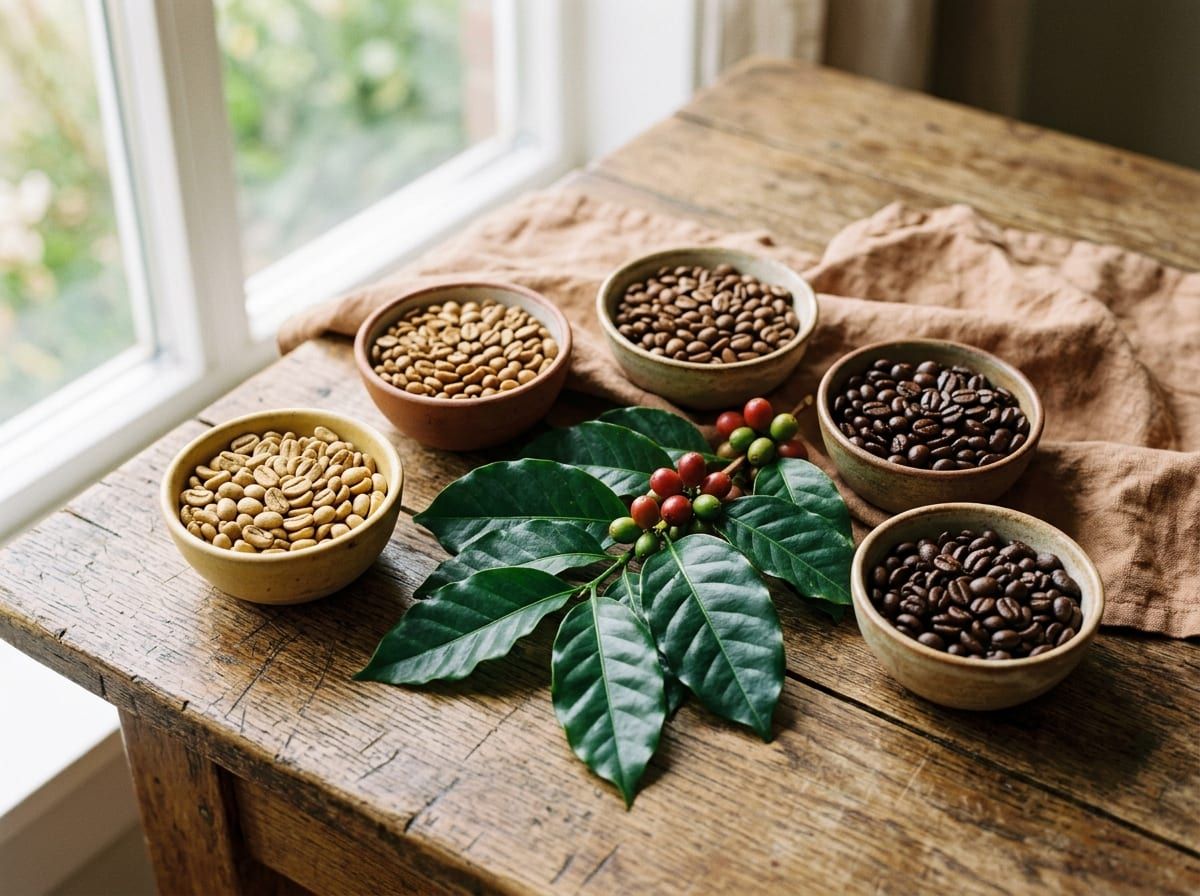
What a variety is and why it matters
The coffee plant, like grapevines or apple trees, comes in hundreds of botanical variants. The species is the broadest division - arabica accounts for about 60% of world production, robusta for most of the rest. Within a species there are varieties: genetic lines with repeatable traits. A variety determines a bean's flavor potential, yield size, disease resistance and altitude requirements. That is why farmers choose varieties the way a grower chooses grain, and roasters increasingly print them on the bag in large letters. For you it is the shortest path to predictable purchases: know the variety and you know roughly what will end up in the cup before you open the bag.
Two foundations: Bourbon and Typica
Almost all traditional arabicas descend from two lines that set out from Ethiopia via Yemen in the 17th and 18th centuries. Typica reached the Americas through India and Java - it gives a clean, sweet and elegant cup, but yields poorly and falls ill easily. Bourbon developed on Bourbon Island (today Reunion) - it is sweeter, more complex, with notes of caramel and red fruit. Their natural mutations produced further classics: the compact Caturra, the productive Catuai and the large-beaned Maragogype.
Specialty stars
Geisha (Gesha) is the most famous premium variety. It comes from an Ethiopian forest near the village of Gesha, but won its fame in Panama when, in 2004, the Hacienda La Esmeralda farm won the Best of Panama competition with it. Its profile - jasmine, bergamot, tea-like lightness - still breaks auction records to this day. In Poland 100-250 g of Geisha costs from around 60 to over 200 zl, while a standard specialty bag is 35-60 zl.
From Kenya come SL28 and SL34 - selections made by the Scott Agricultural Laboratories in the 1930s. They are responsible for the famous Kenyan profile of blackcurrant and grapefruit. El Salvador gave the world Pacamara (a cross of Pacas x Maragogype) with enormous beans and a spicy, fruity character, and Brazil the yellow-ripening Yellow Bourbon and the hardworking Mundo Novo.
Resistant varieties: an answer to rust
Leaf rust (roya) can destroy entire plantations - the 2012-2013 epidemic in Central America cost some countries more than half their harvest. The answer is varieties carrying a share of genes from resistant robusta: Colombian Castillo and the family of Catimors and Sarchimors. They were traditionally considered weaker in the cup, but new selections and careful processing are blurring that difference - Castillo now regularly wins Colombian editions of the Cup of Excellence. A separate chapter is the F1 hybrids (e.g. Centroamericano), combining resistance with quality, still expensive to propagate for now.
Kenya went its own way: alongside the historic SL28 and SL34, its research institute introduced the resistant Ruiru 11 (1985) and Batian (2010). Batian, named after the highest peak of Mount Kenya, combines resistance to rust and CBD (coffee berry disease) with a profile close to the classic SLs - which is why it increasingly appears on labels next to them, without a drop in price.
Where new varieties come from
Every variety came about in one of four ways. Natural mutation: a farmer notices a bush on the plantation unlike the rest - that is how the dwarf Caturra arose from Bourbon (Brazil, 1930s), and the large-beaned Maragogype from Typica. Selection: researchers pick out, from thousands of plants, those with the best traits and propagate them into a pure line - this is the story of the Kenyan SL28 and SL34 and the Ethiopian JARC selections. Crossing: two varieties are combined for a specific effect, like Pacas x Maragogype = Pacamara (El Salvador, 1958) or Caturra x Timor = the Catimor family. F1 hybrids are the newest chapter: laboratory crosses of genetically distant parents that yield offspring more vigorous than either - but only in the first generation, so the seedlings must be cloned in a laboratory, which multiplies their price.
How to read the variety on a label
Roasters list the variety in the origin section, next to the region and processing. A single name ("Caturra") means a harvest from one line - the clearest flavor lesson. A list ("Caturra, Castillo, Colombia") is the typical picture of a Colombian farm, where several varieties grow on one slope and are picked together; the profile is then a blend of them. A "heirloom" or "landrace" label on an Ethiopian coffee says: local, uncatalogued variants - and that is normal, not a lack of data. If no variety is given at all, you are usually dealing with a blend or a commercial coffee. Price can be a hint: Geisha or Pacamara can even double it, so a 35 zl bag reading "Geisha" should raise suspicion, not appetite.
Cheat sheet: variety - profile - where to look for it
| Variety | Cup profile | Typical origin |
|---|---|---|
| Bourbon | caramel, red fruit, sweetness | Rwanda, Burundi, El Salvador, Guatemala |
| Typica | cleanliness, gentle sweetness, balance | Peru, Jamaica, Papua New Guinea |
| Caturra | bright acidity, citrus, caramel | Colombia, Central America |
| Geisha | jasmine, bergamot, tea-like lightness | Panama, Colombia, Ethiopia |
| SL28 / SL34 | blackcurrant, grapefruit, juiciness | Kenya |
| Ethiopian heirloom | flowers, citrus, tea-like body | Ethiopia (Yirgacheffe, Sidama, Guji) |
| Pacamara | tropical fruit, spices, creaminess | El Salvador, Nicaragua |
| Castillo | red fruit, caramel, depending on processing | Colombia |
How to taste the differences between varieties
The fastest lesson is a side-by-side comparison. Buy two coffees that differ only in variety - ideally both washed, lightly roasted, from a similar region - and brew them next to each other with the same method (e.g. V60, 1:16 ratio, water at 93 °C). Smell the dry grounds, then the wet aroma, then taste the coffee once it has cooled: the differences between varieties are clearest below 50 °C. The classic first pair is Bourbon next to an Ethiopian heirloom - chocolate and caramel versus jasmine and citrus. Note your impressions right away, even just three words on the bag: flavor memory without notes fades after two days, and after five such comparisons you already have your own, private map of varieties instead of someone else's descriptions.
Remember the context: a variety is a potential that is realized only in a specific region, at a specific altitude and with specific processing. That is why two SL28s from different farms can differ - but both will be recognizably "Kenyan". You will find the full catalog with descriptions in the coffee varieties section.
Frequently asked questions
- What matters more for flavor: the variety or the region?
- The variety sets the potential; the region and processing decide how much of it is realized. The same Geisha from Panama and from Colombia tastes different, but both will be floral. In practice, read all three together: variety + region + processing is the full description of the profile.
- Why is Geisha so expensive?
- A combination of an exceptional, floral-and-tea-like profile with low yield and enormous demand. Geisha bushes bear few cherries and need high-altitude farms, and the fame began with the Best of Panama auction in 2004. Green beans from the best farms fetch over 10,000 dollars per kilogram at auction; in Poland a 100-250 g bag starts at around 60-80 zl.
- What does 'heirloom' mean on an Ethiopian coffee?
- It is a catch-all label for the thousands of local, often wild arabica variants growing in Ethiopia that no one has yet catalogued. Increasingly roasters give specific selections instead, such as 74110 or 74158, isolated by Ethiopia's JARC research center in the 1970s.
- Can robusta be specialty?
- Yes, though it is still a niche. The best robustas (so-called fine robusta) from Uganda or India are selectively picked and processed like arabica. They have more caffeine (about 2x) and a heavier, nutty-chocolate body, but less acidity and aroma. In specialty, robusta goes mainly into espresso blends.
- Which variety should you start conscious tasting with?
- A contrasting pair: a classic Bourbon or Caturra from Latin America next to an Ethiopian heirloom, both washed and lightly roasted. The difference between a chocolate-caramel and a floral-citrus profile is clear enough that you will feel it without any training.